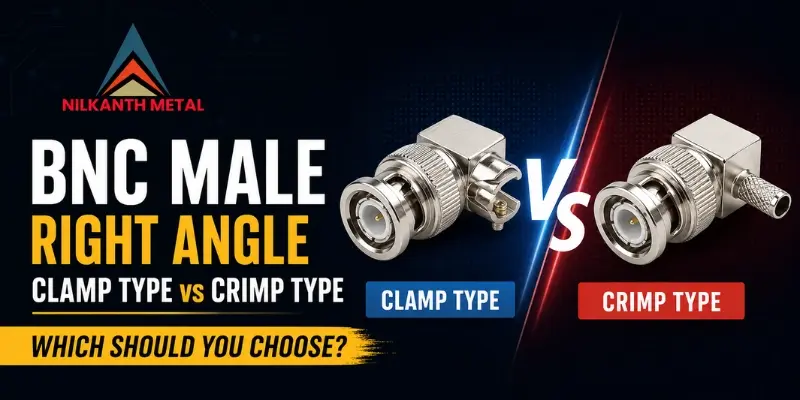
BNC Male Right Angle Clamp Type vs Crimp Type – Which Should You Choose?
There's a moment every installer, technician, or engineer knows well - you're staring at a coaxial cable end and a bag of connectors, and suddenly you're second-guessing whether you ordered the right termination style. The BNC male right angle clamp type is sitting in one hand, a crimp version in the other, and both look nearly identical from three feet away. The difference, though, goes well beyond the mechanism. It affects how long the connection lasts, how easy it is to install, and whether it's appropriate for your specific cable and application at all.
This article breaks down exactly what separates these two connector types - mechanically, practically, and from a signal performance standpoint - so the next time you're speccing a coaxial installation, you're choosing with confidence rather than guessing.
Why the Right-Angle Form Factor Matters Before Anything Else?
A right-angle BNC connector redirects the cable path 90 degrees from the mating interface. That sounds like a small detail until you're trying to fit a cable assembly behind a rack unit with two inches of clearance, or running coax along a wall where a straight-exit connector would force the cable to bend sharply back on itself.
Sharp cable bends are the enemy of coaxial performance and longevity. When the outer jacket and braid bend tightly, the geometry of the cable changes - the spacing between the center conductor and the shield becomes inconsistent, which affects impedance. Over time, repeated stress at a sharp bend point causes the braid to fatigue and the jacket to crack. A right-angle connector eliminates that problem structurally, keeping the cable straight from the point it exits the connector body.
Both the clamp type and crimp type are available in right angle configurations, so the form factor question is settled before you even compare termination methods. What you're choosing between is how the connector physically grips and terminates the cable.
The BNC Male Right Angle Clamp Type: How It Works and Where It Belongs
Mechanical Principle
The BNC male right angle clamp type secures the cable using a clamping nut that tightens over the prepared cable end. After stripping back, the outer jacket and folding the braid, you seat the center conductor into the connector body and thread the clamp nut down over the braid and jacket. The nut compresses the assembly and holds everything in place mechanically.
Twist-on versions - sometimes called screw-on clamp connectors - take this a step further by integrating the thread action into the installation itself. No separate nut tightening, no tools required beyond what your hands can do. This makes them extremely popular for on-site CCTV camera installations, satellite signal distribution, and any setup where a technician needs to terminate a lot of connectors quickly without carrying a toolbox.
Cable Compatibility and Common Applications
Clamp connectors are widely produced for RG59 and RG6 coaxial cable, which covers the vast majority of video surveillance and digital satellite work. They're also available for RG58, the standard 50-ohm cable used in RF test setups and amateur radio installations. Matching the connector to the exact cable diameter is non-negotiable - a connector sized for RG59 will not seat correctly on RG6 because the outer diameter differs enough that the braid won't be captured properly.
The clamp type earns its reputation in field work. When you're terminating connectors in a car park, on a rooftop, or in a ceiling void, the ability to complete a reliable connection without crimping equipment is genuinely valuable. For installations that may also need to be re-terminated - when cable gets cut short during a renovation, for example - the clamp nut can be removed and redone without wasting the connector.
The Crimp Type: Built for Permanence and Consistency
How Crimping Works
A crimp BNC connector uses a metal ferrule - a small cylindrical sleeve - that sits over the cable's prepared braid and jacket. A dedicated crimping tool applies calibrated, even force that permanently deforms the ferrule inward, compressing it tightly around the braid on all sides simultaneously. The center conductor is typically soldered or press-fitted into the contact pin before the ferrule is crimped.
The result is a connection with no movement, no loosening over time, and a 360-degree shield termination that covers the braid more completely than a clamped assembly. Because the crimp is permanent, there's no nut that can back off due to vibration, thermal cycling, or repeated cable movement.
When Crimp Beats Clamp
Broadcast facilities, RF laboratory benches, military-grade electronics, and industrial enclosures all favor crimp termination for exactly this reason. In environments where a connector will be mated and unmated daily, or where temperature swings are significant, the mechanical integrity of a crimped connection outlasts a clamped one. At frequencies above 1 GHz, the tighter, more uniform shield contact of a crimp connector also produces lower return loss - meaning less signal reflected back toward the source.
Crimp connectors are the right answer when you're building cable assemblies that will live inside equipment for years without being touched. The upfront cost of a quality crimping tool with the correct die set pays back quickly across a high-volume production run or a permanent installation with dozens of terminations.
Where the BNC Male to BNC Male Right Angle Adapter Fits In
Not every right-angle connection starts with a cable that needs terminating. Sometimes both ends of a run already have straight BNC connectors, but the physical layout of the equipment demands a 90-degree cable exit. That's exactly the situation where a BNC male to BNC male right angle adapter becomes useful.
These adapters plug into an existing BNC female port on a piece of equipment and present a male BNC interface at 90 degrees, allowing a straight-exit cable to connect without bending. They're common in rack-mounted test equipment, behind AV distribution panels, and in broadcast monitoring setups where cable management is constrained by the equipment layout rather than the cable assembly itself.
The distinction matters when you're sourcing hardware: the BNC male to BNC male right angle adapter is a passive mechanical solution for an existing installation, while the right-angle clamp or crimp connector is a termination choice made at the cable assembly stage. Both solve the same physical problem - right angle cable routing - but they apply at completely different points in the installation process.
Signal Performance: What Actually Differs Between Clamp and Crimp
For video applications below 500 MHz - standard definition CCTV, composite video, and most HD-SDI runs under 50 meters - clamp and crimp connectors produce essentially identical signal performance when both are properly installed. The right-angle geometry itself introduces a minor impedance discontinuity at the bend, but that's a physical geometry effect that both termination styles share equally.
The performance gap opens up at higher frequencies and in harsher environments. RF work above 1 GHz - GPS distribution, microwave test setups, wideband antenna systems - benefits meaningfully from the complete shield coverage of a crimp connector. In outdoor installations subject to vibration, the clamp nut on a right-angle connector can work loose over months, especially on RG6 where the cable's larger diameter means the nut has more surface area to shift against.
For standard indoor CCTV and video distribution, spend less time worrying about clamp versus crimp and more time ensuring the cable is the right impedance, the run length is within spec, and the connectors are seated properly before the final installation is closed up.
Making the Decision: A Practical Framework
The choice between a BNC male right angle clamp type and a crimp connector comes down to three questions: Is this a permanent or serviceable installation? Do you have crimping equipment available? And what frequency range and environment is the cable operating in?
Permanent installation, controlled environment, RF frequencies above 500 MHz - go with crimp. Field installation, video frequencies, need for re-termination flexibility - go with clamp. If you're building a BNC male to BNC male right angle adapter into the setup because the cable assemblies are already made, that removes the termination question entirely and you're just solving a routing problem.
The connector accounts for a small fraction of the total system cost but a disproportionate share of the failures in any coaxial installation. Getting it right at the specification stage - matching termination style to application, cable type to connector size, and impedance to system requirement - is what separates an installation that works reliably for a decade from one that gets a service call six months in.
Recent Post

August, 20 2025
UHF Plug Connector: A Comprehensive Guide



April, 28 2025
Your Trusted Source for High-Quality Brass Air Valves


February, 14 2025
Versatile Brass and Steel Screws Customized for Industrial Sectors

July, 19 2024
What is Core Vents?