What is a BNC Male to BNC Male Right Angle Adapter? A Complete Beginner's Guide
Small connectors often carry big responsibilities. In surveillance systems, broadcast studios, laboratory test setups, and RF communication equipment, a single loose or misaligned connection can throw off an entire system. That is exactly where a BNC male to BNC male right angle adapter earns its place - not as a flashy component, but as a quiet, dependable solution to a very real installation problem.
This guide walks you through what this adapter actually is, how it works, the different variants available, and how to pick the right one for your application. Whether you are setting up a CCTV system for the first time or sourcing connectors for an OEM assembly line, what follows gives you a clear picture of this often-overlooked but widely needed component.
The Basic Anatomy of a BNC Connector
BNC stands for Bayonet Neill–Councilman, named after the engineers who developed it in the late 1940s. The bayonet-style locking mechanism - where you push, twist, and click into place - makes BNC connectors faster to connect and disconnect than threaded types, which is why they became standard in video, RF, and test-and-measurement applications.
A male BNC connector has a centre pin surrounded by an outer cylindrical body with two small locking lugs. A female BNC connector receives that pin and locks around the body when rotated. When you put two male connectors together, you need an adapter with female ports on both ends - or in the case of a right-angle adapter, the connector body itself changes the signal path direction by 90 degrees.
BNC connectors are typically rated for either 50 ohm or 75-ohm impedance. The 50-ohm type is common in RF and radio communication. The 75-ohm type is used in video applications, including CCTV and broadcast. Using the wrong impedance rating introduces signal reflection and degradation, so always verify what your system requires before choosing any adapter.
What a BNC Male to BNC Male Right Angle Adapter Actually Does
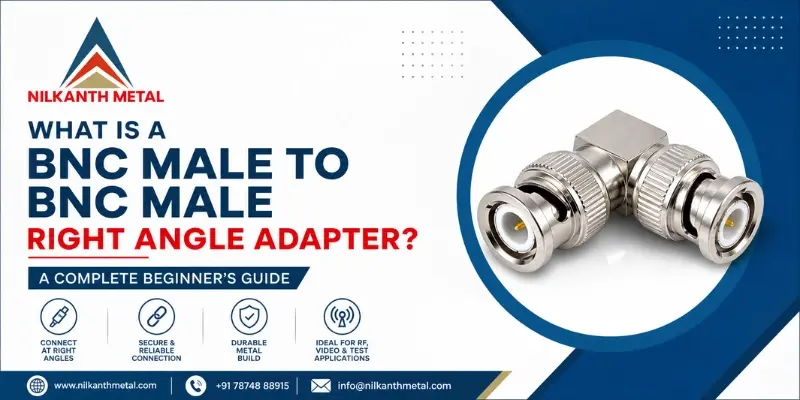
A BNC male to BNC male right angle adapter connects two female BNC ports at a 90-degree angle. Think of it as an elbow joint for your coaxial cable system. One side plugs into a device port, the other side receives a cable or another connector - and the 90-degree bend allows everything to sit flush against a wall, panel, or enclosure without putting mechanical stress on the cable itself.
Without this type of adapter, installers often force cables into awkward bends near the connector. Over time, that physical stress weakens the cable's outer sheath and inner conductor, leading to signal loss or outright failure. A right-angle adapter eliminates that stress by providing a clean, manufactured turn at the connection point.
Where This Adapter Shows Up Most Often
CCTV camera installations are probably the most common use case. When a camera is mounted in a corner or against a wall, the cable exits toward the surface rather than away from it. A right-angle BNC connection lets the cable run cleanly along the wall without creating a visible loop or a bend that could crack the cable over months of exposure.
Broadcast equipment racks are another major application. Signal routing between devices in a tight rack leaves very little room for straight cable exits. Right angle adapters allow neat, organized cable management without sacrificing signal quality. Laboratory oscilloscopes, spectrum analyser’s, and signal generators also commonly use this type of adapter when bench space is limited.
BNC Adapter Variants Worth Knowing
The BNC connector family includes several adapter configurations beyond the standard straight male-to-male or female-to-female types. Understanding these variants helps when you are working with mixed connector systems or dealing with legacy equipment that uses different connector standards.
BNC Male to UHF Female Right Angle
The BNC male to UHF female right-angle adapter bridges two different connector standards at a 90-degree angle. UHF connectors - also known as PL-259 (male) and SO-239 (female) - are common in amateur radio, CB radio, and marine communication systems. When a device has a UHF female port but the incoming cable uses a BNC male connector, this right-angle adapter handles the transition without adding a separate conversion piece in line.
The right-angle form of this adapter is particularly useful in marine and vehicle-mounted radio setups, where space behind the head unit is tight and a straight adapter would push the connected cable directly into a bulkhead or console panel. The 90-degree exit allows clean routing through grommets or along cable channels.
BNC Male Right Angle Clamp Type
A BNC male right angle clamp type connector is a field-terminable connector designed for direct attachment to a coaxial cable at a 90-degree exit angle. Unlike standard crimp or solder connectors that require the cable to exit straight from the rear of the connector body, the clamp type uses a mechanical clamping mechanism to grip the cable at a right angle - meaning the cable exits sideways from the connector.
This type is widely used when assembling custom cable assemblies in the field or at the manufacturing stage. The clamp mechanism provides strong cable retention without needing special crimping tools, which makes it practical for technicians working on-site. It is particularly common in broadcast camera setups, military communication equipment, and industrial data acquisition systems where field termination is necessary.
Material and Build Quality: Why Brass Makes the Difference
Most high-quality BNC adapters are made from brass - an alloy of copper and zinc - and then plated with nickel or gold. Brass offers an excellent combination of electrical conductivity, machinability, and corrosion resistance. For components that carry high-frequency signals, any impurity or surface defect in the connector body can introduce impedance discontinuities and signal degradation, so the material choice matters more than it might seem.
Nickel plating is the standard for most indoor applications - it provides good corrosion resistance and maintains dimensional accuracy over the connector's working life. Gold plating, while more expensive, is used in precision test equipment and high-reliability applications where contact resistance must remain stable over thousands of mating cycles. For outdoor CCTV or marine environments, stainless steel bodies or additional weatherproofing are worth considering.
When evaluating a supplier for BNC male to BNC male right angle adapters, the precision of the centre pin diameter and the bayonet locking mechanism are two things worth verifying. A pin that is even slightly undersized will create intermittent contact, especially in environments with vibration. CNC-machined brass bodies with tight tolerances are the standard for any application where signal reliability is non-negotiable.
Choosing the Right BNC Right Angle Adapter for Your Application
Start with impedance - 50 ohm or 75 ohms. This is the single most important specification and it must match your cable and connected equipment. Mixing impedances causes signal reflections that show up as ghosting in video systems or as reduced sensitivity in RF receivers.
Next, consider the frequency range. Standard BNC adapters are rated up to 4 GHz for 50-ohm types. If you are working with high-definition SDI video or wideband RF signals, verify that the adapter is rated for your frequency range. Low-cost adapters often perform adequately at lower frequencies but introduce measurable insertion loss above 1 GHz.
For bulk procurement or OEM applications, consider suppliers who manufacture in-house with CNC machining capabilities. This allows for custom pin configurations, body lengths, and plating specifications. Jamnagar-based brass component manufacturers in India have become a reliable source for globally compliant BNC adapters at competitive pricing - particularly for B2B buyers sourcing in volume for surveillance equipment, telecom infrastructure, or test and measurement products.
The Right Connector in the Right Place
A BNC male to BNC male right angle adapter is not a complex component - but the problems it prevents are. Signal degradation from a stressed cable bend, intermittent connections from a poorly made centre pin, or a mismatched impedance that undermines an entire RF chain - these are the kinds of failures that a correctly specified adapter quietly prevents every single day.
If you are putting together a system where space is tight and signal quality matters, the right-angle adapter is often the better engineering choice over forcing a straight connector to work. And if you are sourcing for production volumes, working directly with a precision brass manufacturer gives you far more control over quality and lead time than buying generic stock from a distributor.
The next step is straightforward: identify your impedance requirement, confirm the frequency range, and choose a supplier with documented manufacturing standards. Everything else follows from those three decisions.
Recent Post

August, 20 2025
UHF Plug Connector: A Comprehensive Guide



April, 28 2025
Your Trusted Source for High-Quality Brass Air Valves


February, 14 2025
Versatile Brass and Steel Screws Customized for Industrial Sectors

July, 19 2024
What is Core Vents?