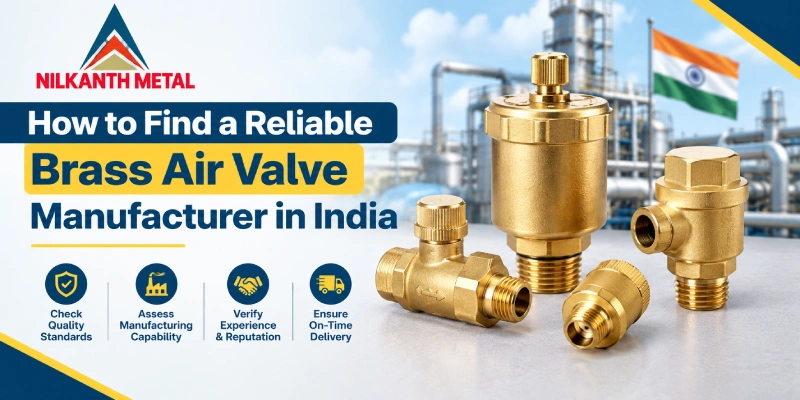
How to Find a Reliable Brass Air Valve Manufacturer in India
A batch of air valves can look perfect on arrival and still fail six months later. The cause is rarely visible: a porous casting, a seat cut slightly off-angle, or a brass alloy that was swapped for a cheaper one somewhere between quotation and dispatch. Choosing a brass air valve manufacturer in India is less about finding the lowest price and more about finding the factory whose process you can verify.
This guide walks through where Indian production is concentrated, what to check on materials and testing, how to read certifications, and how to vet a partner before the first order.
A reliable brass air valve manufacturer in India holds verifiable material certificates, runs pressure testing on every production lot, works to recognised standards such as ISO 9001 or EN 12164, and supplies samples and references before bulk orders. Established clusters like Jamnagar and Mumbai offer the deepest supplier choice.
Where Does India’s Brass Valve Production Actually Happen?
Jamnagar in Gujarat is the centre of Indian brass part manufacturing, with thousands of small and mid-sized units producing forgings, castings, and CNC-turned components. Roughly 5,000 brass workshops are commonly cited for the cluster, and many serve global assemblers directly. That density means a buyer can compare several capable factories within a single trip.
Mumbai, Ahmedabad, Rajkot, and Coimbatore form the second tier. Mumbai and Ahmedabad lean toward trading houses and finished valve assemblers, while Rajkot and Coimbatore carry strong machining and foundry capacity. The region matters because scrap supply, skilled turners, and tooling shops sit close together, which shortens lead times and keeps costs competitive.
Cluster size also creates noise. A listing on an export directory does not tell you whether a company casts its own bodies or simply buys them from a neighbour. Ask early whether the unit is a true manufacturer, a trader, or a supplier who assembles bought-in parts, because each answer changes how much control you will have over quality.
What Should a Brass Air Valve Be Made Of?
Most air valve bodies are forged or machined from brass grades such as CW617N (a hot-forging grade, roughly 58% copper) or CW614N free-cutting brass, with C37700 as the common ASTM equivalent for forgings. Forged bodies are denser than sand castings and rarely show the micro-porosity that causes slow leaks under compressed air.
Alloy chemistry deserves a direct question. A manufacturer should be able to show mill test certificates for each bar or billet batch, listing copper, zinc, and lead percentages. If the supplier hesitates or sends a generic datasheet instead of a batch-specific certificate, treat that as a warning.
Seals and seats matter as much as the body. For compressed air up to 16 bar, NBR (nitrile) seats are the common standard, while PTFE or Viton suits wider temperature ranges and oil-laden air. Stem material, usually brass or stainless steel, also affects cycle life on valves that open and close thousands of times a day.
Lead content has become a purchasing issue in its own right. Valves headed for potable water, food, or pharmaceutical air lines often need low-lead or dezincification-resistant brass. Confirm the target market’s rule before the order, since the wrong alloy can mean rejected shipments at the destination port.
How Can You Verify Quality Before Placing an Order?
Pressure testing is the most telling check, and it should be performed on every lot rather than occasionally. A sound factory tests valves with air or water at typically 1.5 times the rated working pressure and logs results by batch. Ask to see the test bench and a sample of the log sheets.
Dimensional inspection comes next. Thread gauges, go/no-go plugs, and calipers confirm that BSP or NPT threads will mate with your fittings. A stated tolerance, for example ±0.05 mm on critical bores, shows that the factory measures quality rather than assuming it.
The steps below form a practical vetting sequence that works for most first-time orders:
- 1. Request a company profile, GST registration, and IEC (Import Export Code) to confirm legal standing.
- 2. Ask for batch-specific material test certificates for the alloy you need.
- 3. Order paid samples and test them yourself for leakage, thread fit, and cycle life.
- 4. Request references from two export customers in your region.
- 5. Place a small trial order before committing to full volumes.
Factory audits are worth the effort for large contracts. If travel is impractical, third-party inspectors such as SGS, Bureau Veritas, or TÜV will verify processes for a few hundred dollars per visit, often less than the cost of one rejected container.
Which Certifications Actually Matter?
ISO 9001 is the baseline, and it shows that the factory follows documented quality procedures. It does not guarantee a good valve, but its absence in an established manufacturer is a red flag. Check that the certificate is current and issued by an accredited body, since some certificates circulate long after they expire.
Product-level approvals carry more weight than company-level ones. CE marking under the Pressure Equipment Directive matters for European buyers, while ISI marks apply to certain domestic Indian products. Buyers in North America often ask for NSF or ASME compliance depending on application.
Material compliance documents form a third layer. RoHS and REACH declarations confirm limits on restricted substances, and they are increasingly requested by EU importers. A manufacturer who handles export regularly will produce these quickly and without confusion.
What Separates a Manufacturer from a Supplier or Exporter?
A brass air valve manufacturer controls machining, assembly, and testing under one roof, which gives you accountability for defects and room for custom drawings. A brass air valve supplier typically sources from several workshops and sells under one banner, which can work well for mixed orders but dilutes responsibility when something goes wrong.
A brass air valve exporter focuses on documentation, packing, and shipping. Some are manufacturers with dedicated export desks, and others are trading firms. Neither model is wrong, but the distinction affects pricing, customisation options, and who answers the phone when a problem surfaces.
Ask three direct questions to sort them out: where is the forging or casting done, who owns the tooling, and can you visit the machine floor. A genuine manufacturer answers all three without delay and often invites you to see for yourself.
For repeat B2B buying, many importers prefer a manufacturer-exporter hybrid, a factory with its own export department that handles Incoterms, packing lists, and shipping documents directly.
Red Flags and Fair Pricing
Unusually low quotations usually signal a compromise in alloy, wall thickness, or testing. Brass is priced against copper and zinc on commodity markets, so a quote far below peers is hard to explain without a material downgrade. Compare ex-works prices alongside the weight per valve, because a lighter piece often means thinner walls.
Vague answers about lead time are another warning. Standard valves from a stocked manufacturer ship in 2 to 4 weeks, while custom-tooled runs generally take 6 to 10 weeks including tooling. Anyone promising custom parts in a few days is either improvising or reselling stock.
Packaging deserves a look too. Brass threads dent easily, so valves should travel in individual polybags or partitioned cartons, palletised and shrink-wrapped for sea freight. Poor packing damages more shipments than most buyers expect.
Frequently Asked Questions
Which city in India is best for brass valve manufacturing?
Jamnagar in Gujarat is widely regarded as the largest brass manufacturing hub in India, with deep expertise in forging, turning, and component production. Mumbai, Ahmedabad, and Rajkot are also strong, especially for finished valve assembly and export.
How do I check if an Indian brass valve manufacturer is genuine?
Verify the GST registration, IEC code, and ISO 9001 certificate on the issuing body’s website. Then request batch material certificates, order samples, and ask for references from existing export customers.
What is the typical minimum order quantity for brass air valves?
Standard catalogue valves often start at 500 to 1,000 pieces per size. Custom designs usually need higher volumes because of tooling costs, commonly 2,000 to 5,000 pieces.
What pressure rating should a brass air valve have?
For general compressed air lines, valves rated to 16 bar cover most workshop and industrial uses. Hydraulic or high-pressure pneumatic systems may need 25 to 40 bar ratings with heavier-walled forged bodies.
Is a brass air valve better than a stainless steel one?
Brass costs less, machines easily, and handles compressed air, water, and oil without trouble. Stainless steel is better for corrosive media, high temperatures, or hygienic duties, but it costs more.
Choosing Your Partner
The right brass air valve manufacturer will welcome scrutiny, from sample testing to factory visits, because transparency is how good factories win repeat business. Price tells you what a valve costs on day one. Process tells you what it costs over five years.
A sensible first move is to shortlist three manufacturers from different clusters, send each the same drawing and specification sheet, and compare their replies. The one that asks sharp questions about your media, pressure, and thread standard is usually the one that will get the valve right.
Recent Post
August, 20 2025
UHF Plug Connector: A Comprehensive Guide


April, 28 2025
Your Trusted Source for High-Quality Brass Air Valves


February, 14 2025
Versatile Brass and Steel Screws Customized for Industrial Sectors

July, 19 2024
What is Core Vents?