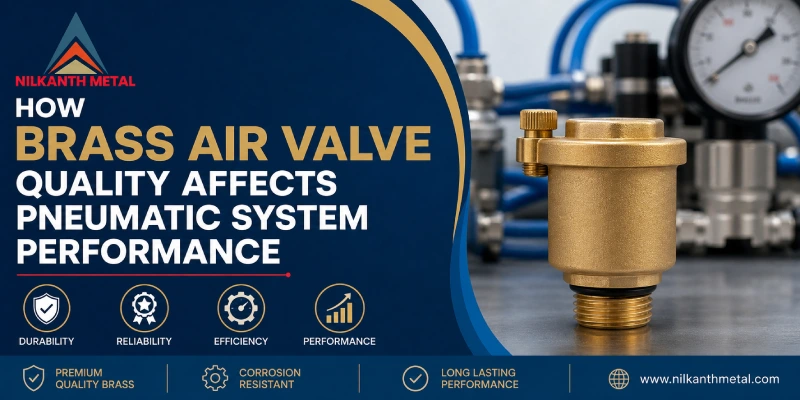
How Brass Air Valve Quality Affects Pneumatic System Performance
A pneumatic system is only as reliable as the smallest valve controlling it, and that's usually a fact plants learn the hard way. Air leaks, pressure drops, and premature seal wear rarely trace back to the compressor or the cylinder — they trace back to a valve that was machined a few thousandths of an inch off spec or cast from an alloy that couldn't handle the duty cycle. This piece breaks down exactly how valve quality shapes system performance and what separates a dependable brass air valve supplier from one that's cutting corners.
Brass air valve quality directly determines pneumatic system efficiency because even minor dimensional or alloy inconsistencies cause air leakage, pressure loss, and accelerated wear at seals and seats. A well-machined valve with tight tolerances and correct alloy composition holds pressure consistently, while a poorly made one bleeds air, forces compressors to work harder, and fails months ahead of schedule.
Why Valve Quality Matters More Than Most Engineers Assume
Pressure loss compounds quietly across a pneumatic system, and a single undersized or poorly sealed valve can account for a meaningful share of total system inefficiency. Industry estimates commonly cite compressed air leaks costing facilities between 20 and 30 percent of total compressor output in poorly maintained systems, and valves are one of the most common leak points alongside fittings and hose connections.
Surface finish inside the valve body affects flow resistance in ways that aren't visible from the outside. A rough or poorly deburred bore creates turbulence that reduces effective flow rate, forcing the system to run at higher pressure than necessary just to deliver the same actuation force downstream.
Dimensional consistency across a production batch matters just as much as any single valve's quality. If tolerances drift from one batch to the next, technicians end up hand-fitting seals or adjusting torque specs part by part, which turns a simple component swap into a diagnostic exercise on the shop floor.
How Does Brass Alloy Composition Affect Valve Durability
Alloy selection determines how a valve behaves under sustained pressure cycling, not just how it looks when new. Standard CW617N (CZ121) brass, roughly 58-60 percent copper with balanced zinc and lead content, remains the industry default for pneumatic valve bodies because it machines cleanly and resists dezincification reasonably well in most compressed air environments.
Lead content plays a specific mechanical role that's easy to overlook. A small percentage of lead, typically around 2-3 percent, improves machinability and helps the valve hold tight tolerances during high-volume production, though some regions now require lead-free alloys for potable water or food-contact air lines, which changes both cost and machining behaviour.
Dezincification resistance separates a valve built for long service life from one that will corrode within a year or two. In systems exposed to humid air, condensation, or chloride-heavy environments, a DZR-rated brass alloy resists the selective leaching of zinc that otherwise weakens the valve body from the inside out, often years before any external sign of failure appears.
Choosing Between a Manufacturer and an Exporter
The distinction between a brass air valve manufacturer and a brass air valve exporter matters more than buyers often realize when quality control is the priority. A manufacturer controls the casting, machining, and testing process directly, which means defects can be traced to a specific production stage and corrected at the source.
An exporter, by contrast, often aggregates valves from multiple factories and may not have direct visibility into alloy certification, pressure testing records, or batch-level quality data. That's not automatically a problem, since many reputable exporters maintain strict supplier audits, but buyers sourcing for critical applications generally get more consistent results going straight to a verified brass air valve manufacturer with in-house testing.
Working with either type of partner successfully comes down to documentation. A supplier that can produce material certificates, pressure test reports, and dimensional inspection data for every batch is signalling a level of process control that a price quote alone never reveals.
What Testing Standards Should a Reliable Valve Pass
Pressure and leak testing form the baseline any pneumatic valve should clear before it ships. Most industrial brass valves are tested to at least 1.5 times their rated working pressure during hydrostatic testing, with air-specific units additionally checked for seat leakage under working pressure using a bubble-tight or ISO 5599 leakage classification.
Salt spray testing predicts how a valve will hold up in corrosive or coastal environments over time. A valve rated for 96 to 200 hours of salt spray exposure without significant surface degradation gives a reasonable proxy for multi-year performance in humid industrial settings, though actual service life still depends heavily on maintenance and air quality.
| Test Type | What It Measures | Typical Standard |
|---|---|---|
| Hydrostatic pressure test | Body strength under overpressure | 1.5× rated working pressure |
| Seat leakage test | Air-tightness when closed | ISO 5599 or bubble-tight |
| Salt spray test | Corrosion resistance | 96–200 hours (ASTM B117) |
| Cycle/endurance test | Long-term seal and actuator wear | 100,000+ cycles common |
Cycle testing, sometimes overlooked in spec sheets, reveals how a valve performs after tens of thousands of open-close cycles rather than in a single static test. A valve rated for 100,000 cycles or more without measurable leakage increase gives a far more honest picture of real-world durability than a one-time pressure check ever could.
Practical Steps for Sourcing a Dependable Supplier
Requesting material certification for every batch prevents the single most common quality failure in brass valve sourcing: undisclosed alloy substitution. A certificate specifying exact copper, zinc, and lead percentages, tied to a traceable heat number, lets a buyer verify what they're actually receiving rather than trusting a spec sheet alone.
Auditing a facility's in-house testing capability, even remotely through documentation, separates a serious brass air valve supplier from one relying purely on final inspection. Suppliers with in-line pressure testing on every unit, rather than statistical batch sampling, catch defects before they reach a customer's assembly line.
Reviewing first-article samples under actual operating conditions, not just visual inspection, catches problems that paperwork alone misses. Running a small batch through the exact pressure, cycle rate, and environmental conditions of the intended application for two to four weeks before committing to a full order is a low-cost way to surface issues early.
Building a relationship with a single trusted brass air valve supplier over multiple orders, rather than switching sources purely on quote price, tends to pay off in fewer surprises. Repeat suppliers become familiar with a buyer's specific tolerance requirements and operating environment, which shows up as fewer out-of-spec batches and faster resolution when something does go wrong.
Frequently Asked Questions
What causes a brass air valve to leak?
Leaks usually come from worn or improperly seated O-rings, dimensional inconsistency in the valve seat, or dezincification corrosion weakening the brass body over time. Overtightened fittings during installation can also deform the valve body enough to create a slow leak that worsens under pressure cycling.
How long should a brass air valve last in industrial use?
A properly specified and maintained brass air valve typically lasts three to seven years in continuous industrial service, though actual lifespan depends heavily on air quality, cycle frequency, and environmental exposure. Valves in filtered, dry air systems with moderate cycling often exceed this range considerably.
Is brass better than plastic or stainless steel for pneumatic valves?
Brass offers a strong balance of machinability, cost, and corrosion resistance that makes it the default choice for most pneumatic applications, while stainless steel is reserved for highly corrosive or high-temperature environments where the added cost is justified. Plastic valves are lighter and cheaper but generally can't match brass on pressure rating or long-term durability under repeated cycling.
How do I verify a brass air valve supplier's quality claims?
Request material certificates with traceable heat numbers, ask for recent pressure and leak test reports, and where possible visit or virtually audit the production facility. A supplier confident in their process will typically provide this documentation without hesitation rather than deflecting to generic marketing claims.
What's the difference between forged and cast brass valve bodies?
Forged brass valve bodies generally have a denser, more uniform grain structure that resists cracking under pressure better than cast bodies, making them the preferred choice for higher-pressure or safety-critical applications. Cast bodies remain common in lower-pressure, cost-sensitive applications where the performance difference matters less.
Recent Post
August, 20 2025
UHF Plug Connector: A Comprehensive Guide


April, 28 2025
Your Trusted Source for High-Quality Brass Air Valves


February, 14 2025
Versatile Brass and Steel Screws Customized for Industrial Sectors

July, 19 2024
What is Core Vents?