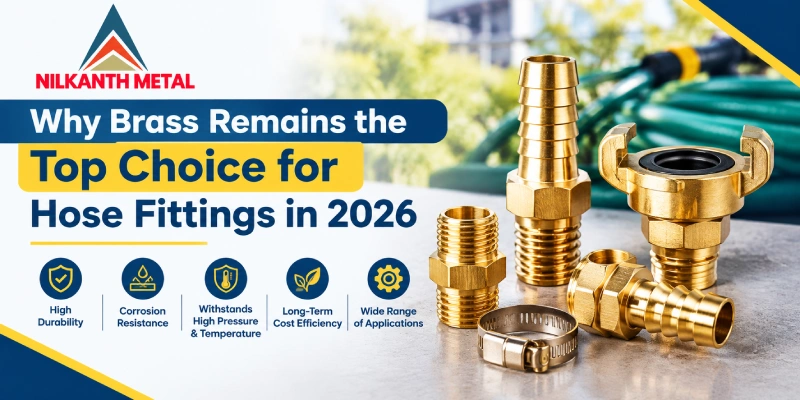
Why Brass Remains the Top Choice for Hose Fittings in 2026
Walk through any workshop, farm, or plant floor and count the hose connections. Most of the ones that never leak, never seize, and never get a second thought are brass. A brass hose tee splitting a compressed air line is about as unglamorous as industrial hardware gets, yet it has outlasted every “replacement” material pitched against it for decades.
This article explains why brass keeps winning, how the common fitting shapes differ, where brass should not be used, and what to check before buying in volume.
Brass remains the top choice for hose fittings in 2026 because it combines corrosion resistance, easy machining, reliable sealing, and moderate cost. A brass hose tee, elbow, or nipple handles water, compressed air, oil, and most fuels at pressures up to roughly 16 to 25 bar without the cracking, creep, or rust that affect other materials.
What Makes Brass So Hard to Replace?
Brass is an alloy of copper and zinc, typically around 57 to 63% copper, and that chemistry produces a rare mix of properties in one metal. It resists corrosion in water, air, and oil. It machines cleanly at high speed. It also stays slightly softer than steel, so threads seal against each other rather than galling.
Machinability is the quiet reason behind brass’s cost advantage. Free-cutting grades such as CW614N rate around 90 on the standard machinability scale (the benchmark is 100), while stainless steel sits near 40 to 50. A CNC lathe turns brass faster, wears tools less, and holds tolerances tighter, which keeps unit prices low even at modest volumes.
Brass also tolerates the temperature swings real systems produce. Most fittings perform steadily from roughly -20 °C to 120 °C, which covers outdoor air lines in winter and hot-water service alike. Plastics soften or turn brittle at the edges of that range, and zinc-coated steel starts to flake.
Recyclability adds a late-stage benefit. Scrap brass retains most of its value, and processors recover it at very high rates. For buyers tracking environmental reporting in 2026, that is a documented advantage that polymer fittings struggle to match.
How Do the Common Brass Hose Fittings Differ?
Each fitting shape solves a specific routing problem, and picking the wrong one is the most frequent source of avoidable leaks. Four types account for most orders in air, water, and fuel systems.
A brass hose tee splits one line into two or joins two into one, using three ports at 90 degrees. Equal tees keep all ports the same size, while reducing tees step down one branch, which suits compressors feeding smaller tool lines. Tees are also the usual home for gauges, drain valves, and pressure switches.
A brass hose elbow male turns a line through 90 degrees while giving a threaded male end that screws straight into a manifold, tank, or pump port. It replaces a bent hose that would otherwise kink under pressure. The elbow keeps tight spaces tidy and protects hose ends from fatigue.
A brass hose nipple male has a ribbed barb on one end for the hose and an external thread on the other. A brass hose nipple female uses an internal thread instead, so it mates with a male pipe or fitting. Choosing between them depends on which side of the joint already carries the thread.
Here is how the four compare at a glance:
| Fitting | Ports | Best Use | Typical Thread |
|---|---|---|---|
| Hose Tee | 3 (barb or threaded) | Splitting or joining lines | BSP or NPT |
| Hose Elbow Male | Barb plus male thread | Tight 90° turns into a port | BSP or NPT |
| Hose Nipple Male | Barb plus male thread | Hose to female port | BSP or NPT |
| Hose Nipple Female | Barb plus female thread | Hose to male port | BSP or NPT |
Why Does Brass Seal Better Than Plastic or Steel?
Brass seals well because it deforms just enough under thread pressure to fill tiny gaps without cracking. Tapered threads such as NPT and BSPT wedge together as they tighten, and brass yields slightly against a steel mating part, producing a metal-to-metal seal that PTFE tape or paste then finishes.
Plastic fittings rely on the same geometry but behave differently over time. Polypropylene and nylon creep under sustained load, so a thread that feels tight on day one can loosen after several months of vibration or heat cycling. Brass holds its shape through those cycles.
Steel threads are harder and less forgiving. Carbon steel rusts at the joint, and stainless steel galls when dry-threaded, sometimes seizing so tightly that the fitting must be cut out. Brass avoids both problems, which is why maintenance crews favour it on lines they expect to service.
Vibration is where the gap widens most. Compressors, pumps, and agricultural machinery shake fittings constantly, and brass absorbs that movement without fatigue cracking at the barb or thread root.
Where Should You Avoid Brass Fittings?
Brass is not universal, and knowing its limits prevents expensive failures. Ammonia causes stress corrosion cracking in copper alloys, so refrigeration and fertiliser lines need stainless steel. Acetylene can form unstable compounds with copper-rich metals, which makes brass unsuitable for that gas.
Seawater and strong acids also attack standard brass through dezincification, where zinc leaches out and leaves a porous, weak copper skeleton. Marine and chemical services should use DZR (dezincification-resistant) brass or stainless steel instead.
Drinking-water lines bring their own rules. Many markets cap lead content at 0.25% weighted average in wetted surfaces, which excludes conventional free-cutting brass. Lead-free silicon brass grades meet that limit and are now routine for potable applications.
High-temperature steam above roughly 150 °C and very high pressure beyond 40 bar also call for forged steel or stainless parts. Brass loses strength as temperature climbs, so ratings drop sharply beyond its comfort zone.
What Should Buyers Check Before Ordering Brass Hose Fittings in Bulk?
Material certification comes first. A genuine supplier provides mill test certificates showing copper, zinc, and lead percentages for each batch, and the alloy should match the grade on the quotation. Mismatched chemistry is the leading cause of cracked barbs and failed pressure tests.
Thread accuracy comes next. Confirm whether the order uses BSP parallel, BSPT tapered, or NPT, since these look similar but do not seal together. A reputable manufacturer holds tolerances around ±0.05 mm on thread pitch and gauges samples from each lot.
Forged bodies outperform sand-cast ones for pressure work. Forging compresses the metal and removes the micro-porosity that causes seeping leaks in compressed air service. Ask directly whether a fitting is hot-forged, machined from bar, or cast.
Testing and packing finish the checklist. Look for lot-wise pressure tests at about 1.5 times working pressure, and individual bagging or partitioned cartons that protect threads in transit. Lead times of 2 to 4 weeks are normal for catalogue sizes, and 6 to 10 weeks for custom tooling.
Frequently Asked Questions
Why are brass fittings used for hoses?
Brass resists corrosion in water, air, and oil, machines to tight tolerances, and seals reliably against steel and copper pipe. It also costs less than stainless steel. Those combinations make it the default for general hose connections.
What is a brass hose tee used for?
A brass hose tee splits one flow into two directions or merges two flows into one. It is common on compressed air manifolds, irrigation lines, and fuel or lubrication circuits. Reducing versions step down one branch to a smaller hose size.
What is the difference between a male and female hose nipple?
A male hose nipple carries an external thread, while a female hose nipple carries an internal one. Both have a barbed end for the hose. Pick the one that mates with the thread already on your equipment.
Is brass safe for drinking water?
Standard free-cutting brass contains lead and may not meet potable-water rules in many markets. Lead-free or low-lead brass, such as silicon brass or DZR grades, is the correct choice. Always confirm the certification for your target country.
How long do brass hose fittings last?
In clean air, water, or oil service, brass fittings commonly last 15 to 25 years. Service life drops with aggressive media, heavy vibration, or repeated over-tightening. Regular inspection of thread condition helps catch problems early.
Brass has survived every material trend of the past fifty years because its strengths show up in daily use rather than in marketing claims. A well-made brass hose tee, elbow, or nipple costs little, installs fast, and rarely returns as a complaint.
Before the next bulk order, list the media, pressure, temperature, and thread standard for each line, then request samples with batch certificates from two or three manufacturers. Testing five pieces on your own bench will teach you more than any catalogue.
Recent Post
August, 20 2025
UHF Plug Connector: A Comprehensive Guide


April, 28 2025
Your Trusted Source for High-Quality Brass Air Valves


February, 14 2025
Versatile Brass and Steel Screws Customized for Industrial Sectors

July, 19 2024
What is Core Vents?