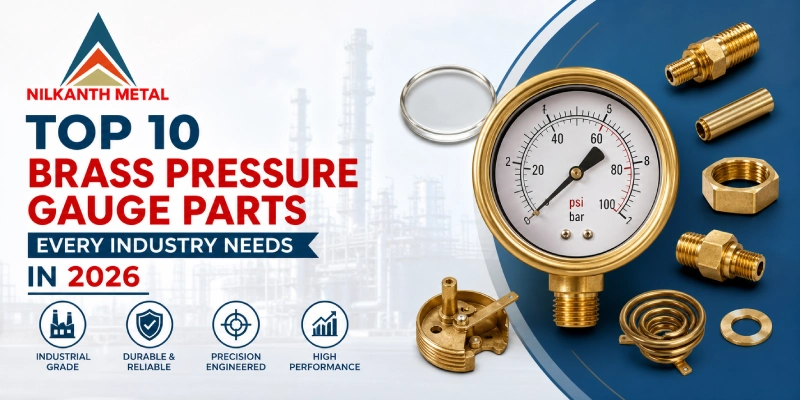
Top 10 Brass Pressure Gauge Parts Every Industry Needs in 2026
Walk into any compressor room, boiler plant, or fluid-handling facility, and you'll find brass doing quiet, unglamorous work behind every dial. Brass pressure gauge parts hold pressure systems together in ways that rarely get noticed until something fails. For procurement teams and plant engineers heading into 2026, knowing exactly which components matter - and why - saves both downtime and budget.
This guide breaks down the ten brass pressure gauge parts that show up most often on purchase orders this year, what each one actually does, and how to buy them without getting burned by low-grade substitutes.
Brass pressure gauge parts include bourdon tubes, movements, adapters, isolation valves, snubbers, and bezels, each machined from brass alloys chosen for corrosion resistance and dimensional stability. Industrial buyers rely on them because brass tolerates repeated pressure cycling, resists most process fluids, and machines to tight tolerances without cracking under vibration.
Why Brass Still Dominates Pressure Gauge Manufacturing
Brass earned its place in gauge manufacturing decades ago, and nothing has displaced it. The alloy - typically a copper-zinc mix in the C36000 or C26000 family - resists dezincification better than most low-cost alternatives, which matters directly in water, oil, and mild chemical service.
Machinability is the other half of the story. Brass cuts cleanly on CNC lathes, holds threads without galling, and accepts brazing and soldering at temperatures that don't distort thin-walled bourdon tubes. A shop can turn out a finished adapter fitting in under two minutes on modern equipment, which keeps unit costs manageable even for custom thread configurations.
Stainless steel edges out brass in highly corrosive or high-temperature environments above roughly 250°F, but for the vast majority of HVAC, compressed air, and general industrial pressure monitoring, brass remains the default material specified on drawings.
What Are the Core Brass Pressure Gauge Parts in an Assembly?
A complete gauge assembly is really a stack of individual brass components, each engineered for one specific job. Here's the breakdown buyers ask for most:
- 1. Bourdon Tube - the curved, flattened tube that straightens slightly under pressure, driving the needle. Wall thickness typically runs 0.3mm to 0.5mm depending on the pressure range.
- 2. Movement Assembly - the gear-and-pinion mechanism that translates the bourdon tube's tiny deflection into a full needle sweep, usually amplifying motion by a factor of 200 to 300.
- 3. Socket/Connection - the threaded base connecting the gauge to the process line, commonly ¼" or ½" NPT or BSP.
- 4. Bezel Ring - the outer rim securing the dial window, often crimped or threaded onto the case.
- 5. Adapter Fittings - reducers and extensions that match gauge threads to non-standard pipe connections.
- 6. Isolation (Needle) Valves - shutoff valves allowing gauge removal without draining the whole system.
- 7. Snubbers - small restrictors that dampen pressure spikes and pulsation, extending gauge life significantly.
- 8. Siphon Tubes - coiled or pigtail fittings protecting the gauge from steam or high-temperature media.
- 9. Restrictor Screws - fine-adjustment components limiting flow into the bourdon tube during sudden surges.
- 10.Case and Ring Assembly - the outer housing, frequently brass-plated or solid brass in industrial-grade gauges rated for outdoor or corrosive exposure.
Each of these parts is sold both as OEM replacement stock and as standalone components, which is why so many industrial buyers keep a running relationship with a dedicated brass pressure gauge parts supplier rather than sourcing piecemeal from general hardware distributors.
How Does Material Grade Affect Gauge Performance and Lifespan?
Not all brass is equal, and this is where a lot of buyers get caught out. C36000 brass, sometimes called free-cutting brass, machines beautifully but carries higher lead content and slightly lower corrosion resistance than C26000 cartridge brass.
For potable water or food-grade applications, C26000 or lead-free brass alloys are the safer specification, even though they cost roughly 15-20% more per kilogram. A bourdon tube made from the wrong grade in a corrosive service line can develop pinhole leaks within 18 months instead of lasting the typical 5 to 7 years.
Vibration is the second major lifespan factor. Snubbers and needle valves aren't optional extras on compressor or pump discharge lines - they routinely double or triple gauge service life by smoothing out the pressure pulses that fatigue bourdon tubes prematurely.
Sourcing Brass Pressure Gauge Parts: What Buyers Should Check in 2026
Global brass pricing has stayed volatile through 2025 into 2026, tracking copper and zinc commodity swings, so landed cost isn't the only number that matters anymore. Buyers evaluating a brass pressure gauge parts exporter should confirm alloy certification, not just a quoted price per unit.
Request mill test certificates for any bulk order above a few hundred units. A reputable exporter provides these without hesitation, since it's standard documentation for industrial procurement and protects both sides if a batch underperforms.
Lead times deserve equal attention. Custom thread configurations or non-standard bourdon tube ranges can add three to six weeks to a production run, so ordering against forecasted need rather than reactive need keeps plants from scrambling during peak maintenance seasons.
Common Failure Points and How to Avoid Them
Threaded connections fail more often than any other part of the assembly, usually from over-torquing during installation rather than material defect. A brass socket cross-threaded with a wrench instead of hand-tightened first will crack under pressure cycling within weeks.
Dial fogging and bezel corrosion typically trace back to a gasket seal that wasn't rated for the ambient environment, not the brass itself. Swapping to a nitrile or Viton gasket during bezel replacement solves most of these complaints permanently.
Bourdon tube fatigue, the most expensive failure to diagnose, almost always comes down to pressure spikes exceeding the gauge's rated range. Installing a snubber or restrictor screw costs a fraction of a full gauge replacement and addresses the root cause directly.
Frequently Asked Questions
What is the average lifespan of brass pressure gauge parts?
A well-specified brass gauge assembly typically lasts 5 to 7 years in normal industrial service. Harsh vibration, incorrect alloy selection, or missing snubbers can cut that lifespan to under two years
Are brass pressure gauge parts interchangeable across brands?
Threaded connections following NPT or BSP standards generally interchange across manufacturers, but bourdon tube ranges and movement gear ratios are often proprietary. Always match the exact pressure range and dial size before swapping parts.
Why do brass pressure gauge parts cost more than plastic alternatives?
Brass costs more upfront because of raw material pricing and machining time, but it outlasts plastic components by several years in most industrial settings, which lowers total cost of ownership over the gauge's working life.
Can brass pressure gauge parts be used with steam applications?
Yes, provided a siphon tube or pigtail fitting is installed to cool the steam before it reaches the bourdon tube. Direct steam contact without a siphon will damage the tube within a short period.
How do I know if I need a snubber or a needle valve?
A snubber addresses pressure pulsation and spikes, while a needle valve allows the gauge to be isolated and removed for service or calibration. Most industrial installations benefit from having both.
Brass pressure gauge parts don't get much attention until a reading drifts or a needle sticks, and by then the fix usually costs more than prevention would have. Building a relationship with a supplier who documents alloy grades, holds consistent lead times, and understands your specific pressure range will do more for uptime in 2026 than chasing the lowest per-unit price ever will.
Recent Post

August, 20 2025
UHF Plug Connector: A Comprehensive Guide



April, 28 2025
Your Trusted Source for High-Quality Brass Air Valves


February, 14 2025
Versatile Brass and Steel Screws Customized for Industrial Sectors

July, 19 2024
What is Core Vents?