Brass Pressure Gauge Parts: Types, Functions & Applications
A pressure gauge looks simple from the outside: a round dial, a needle, a threaded stem. Inside that small case sits a mechanism that has barely changed since Eugène Bourdon patented his curved-tube design in 1849, and much of it is made from brass. Understanding brass pressure gauge parts , what each one does and where each one fails, saves procurement teams from reorders, leaks, and misread dials.
This guide covers the components, the alloys behind them, the media they suit, and what to ask before placing an order.
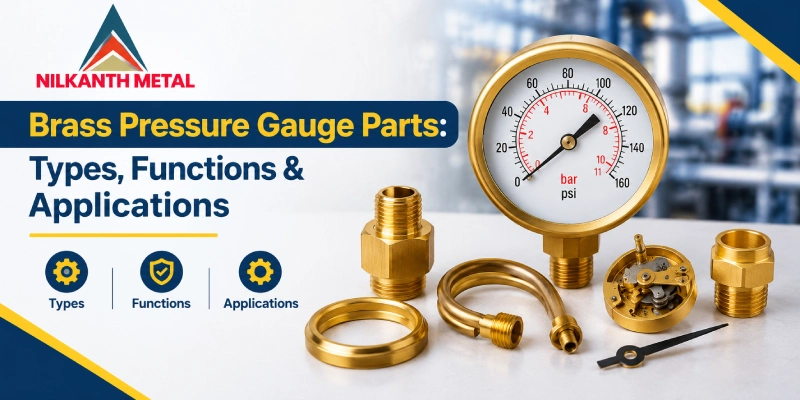
The core parts of a brass pressure gauge are the socket, Bourdon tube, movement, dial, pointer, bezel, and case, and together they convert fluid pressure into needle movement. Brass is chosen for its machinability, corrosion resistance in water, air, and oil, and moderate cost.
The Core Brass Pressure Gauge Parts and What Each One Does
The socket is where every gauge meets the process line. It is a machined brass stem with a thread, typically G1/4 (BSP) or 1/4 NPT, and a bore that channels pressure into the tube. Thread mismatch is a frequent reason for returned shipments, so confirm the standard before anything else.
The Bourdon tube is the part that actually senses pressure. It is a flattened, curved tube sealed at one end; as pressure rises inside, the tube tries to straighten, and the free tip moves a small, predictable distance. Copper alloy tubes such as phosphor bronze suit low to medium ranges, while steel is the usual choice once pressure climbs past roughly 60 bar.
The movement turns that tiny tip travel into a readable sweep. A link connects the tube tip to a toothed sector, the sector drives a pinion, and the pinion carries the pointer across the dial. A hairspring takes up backlash so the needle does not flutter between readings. Brass gears are standard here because they machine cleanly and wear evenly.
The dial, pointer, bezel, window, and case make up the outer shell. Dial sizes follow common steps of 40, 50, 63, 100, and 160 mm. The bezel, either crimped or bayonet-ring, holds the window, which is glass in most industrial models and acrylic where breakage is a concern. A blow-out disc at the back of the case lets pressure escape safely if the tube ruptures.
Common Types of Gauge Components and the Materials Behind Them
Most orders for brass pressure gauge parts cluster around a handful of components, and the alloy changes with the job. The table below maps the ones that come up most often.
| Part | Typical material | Main job |
|---|---|---|
| Socket | Free-cutting brass (CW614N, C36000) | Connects gauge to the line |
| Bourdon tube | Phosphor bronze or brass | Senses pressure |
| Movement | Brass gears, steel spring | Converts tip travel to rotation |
| Restrictor | Brass | Limits pulsation |
| Dial and pointer | Aluminium | Shows the reading |
| Bezel ring | Brass or stainless steel | Holds the window |
Free-cutting brass dominates socket production for a practical reason. Grades like C36000 contain about 3% lead, which breaks machining chips cleanly and lets a CNC lathe cut threads at high speed with tight tolerances. For drinking-water or food-contact work, lead-free grades such as C69300 silicon brass are the safer specification.
Beyond materials, parts come in distinct types tied to the gauge style. Dry gauges use a plain movement, while liquid-filled gauges add a sealed case with glycerine or silicone oil, which damps needle vibration from pumps and compressors. Bottom-entry (radial) and back-entry (axial) sockets are the two main mount types, and panel-mount versions add a front flange or clamp ring.
How Do You Choose the Right Brass Part for Your Process Media?
Brass suits water, compressed air, hydraulic oil, diesel, and most non-corrosive gases. Standard gauge designs are rated for media up to about 60 °C, so steam and hot-oil lines need a pigtail siphon between the line and the socket.
Two exclusions matter more than any others. Ammonia attacks copper alloys through stress corrosion cracking, and acetylene can react with copper-rich alloys to form shock-sensitive compounds, so both need stainless steel parts. Oxygen service demands brass that has been cleaned oil-free and marked accordingly, because hydrocarbon residue can ignite under compression.
Pressure range deserves the same attention as chemistry. EN 837-2 guidance caps working pressure at 75% of full scale under steady load and 65% where it fluctuates. A 0–10 bar dial on a line that peaks at 9.5 bar will fatigue its tube long before the rated life ends.
Pulsating lines call for a restrictor or snubber, a small brass insert with a narrow orifice that slows the pressure surge reaching the tube. Without one, the pointer whips, the gears wear early, and readings become guesses.
Where Do Brass Gauge Components End Up in Industry?
HVAC and plumbing are the most familiar homes for brass gauges. Boiler feed lines, chilled-water loops, and fire-sprinkler risers all run on water at moderate pressure, which is exactly where brass performs best and costs least.
Compressed air systems are the next big user. Workshop compressors, pneumatic tools, and spray booths typically carry 50 or 63 mm gauges reading 0–16 bar, often fitted by the hundreds on OEM equipment where consistency between batches matters more than any single specification.
Hydraulics and fuel handling form a third group. Hydraulic power packs, fuel dispensers, and lubrication systems use liquid-filled brass gauges because vibration is constant. LPG regulators and gas cylinders also rely on brass fittings and gauge sockets, since brass resists corrosion from propane and butane.
Export demand follows these same sectors. An exporter of brass pressure gauge parts, especially one working out of an established brass cluster like Jamnagar in India, typically ships turned sockets, Bourdon tubes, and finished movements to assemblers in Europe, the Middle East, and Africa, where assemblers often prefer buying components over machining them in-house.
What to Ask a Brass Pressure Gauge Parts Supplier Before You Order
Material certification comes first. A reputable supplier provides mill test certificates showing the alloy composition, and a manufacturer working to EN 12164 or ASTM B16 for brass bar stock can trace each batch back to the melt.
Dimensional control comes second. Thread gauges, go/no-go checks, and a stated tolerance, such as ±0.05 mm on the socket bore, show that quality is measured rather than assumed. Ask for a sample and test the fit on your own assembly line.
Pressure testing separates a finished part from a promising one. Sockets and tubes should pass a leak test with results logged per lot, and a gauge assembly should state its EN 837-1 accuracy class, usually 1.6 or 2.5 for general industrial work.
Packaging and lead time round out the checklist. Brass scratches easily in transit, so individual bagging or partitioned cartons matter. Established exporters often quote 3 to 6 weeks for a custom-machined run, depending on tooling, and keep standard sockets in stock for faster dispatch.
Frequently Asked Questions
What are the main parts of a brass pressure gauge?
The main parts are the socket, Bourdon tube, movement, dial, pointer, bezel, window, and case. The socket and tube handle pressure, while the movement and pointer turn it into a reading. The remaining parts protect the mechanism and keep the dial readable.
Why is brass used for pressure gauge parts?
Brass machines quickly, holds fine threads, and resists corrosion in water, air, and oil. It is also cheaper than stainless steel, which keeps high-volume gauge production affordable. The trade-off is limited compatibility with ammonia and acetylene.
What is the difference between a brass and a stainless steel pressure gauge?
Brass wetted parts suit clean, non-corrosive media at lower cost, while stainless steel handles aggressive chemicals, higher pressures, and hygienic duties. Stainless costs noticeably more. Many buyers pair a brass socket with a stainless case, a mid-priced compromise for outdoor installations.
How often should brass gauge components be replaced?
Gauges in critical service are usually calibrated at least once a year, and sooner after a pressure spike or visible needle drift. Tubes and movements wear with cycling, so gauges on pulsating lines age faster than those on static lines. A pointer that fails to return to zero is the clearest warning.
Can brass gauge parts be made to custom drawings?
Yes. A capable manufacturer can machine sockets to custom thread forms, bore sizes, and lengths from a drawing or sample. Minimum order quantities usually apply for non-standard tooling, so confirm them before approving a design.
A Practical Next Step
The best brass pressure gauge parts are rarely the cheapest ones on a quotation. They are the ones whose alloy, thread, and tolerance were matched to a specific medium and pressure range before any metal was cut.
Before the next purchase order goes out, write down the fluid, the maximum working pressure, the pulsation level, and the thread standard on a single sheet, then send it with a drawing to two or three exporters and compare how each one responds. The quality of their questions will tell you more than the price.
Recent Post

August, 20 2025
UHF Plug Connector: A Comprehensive Guide



April, 28 2025
Your Trusted Source for High-Quality Brass Air Valves


February, 14 2025
Versatile Brass and Steel Screws Customized for Industrial Sectors

July, 19 2024
What is Core Vents?