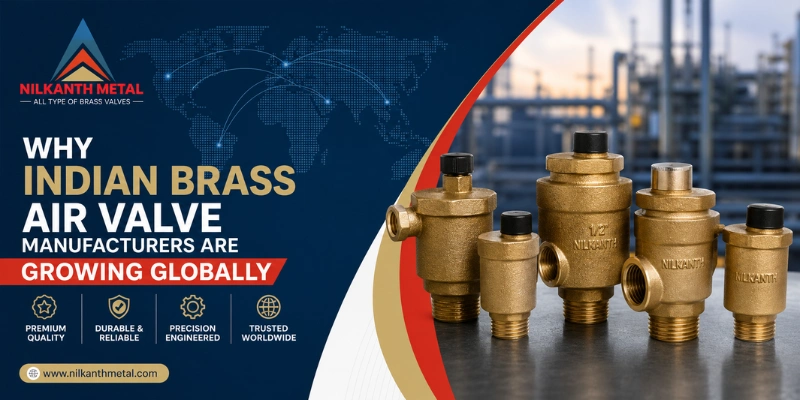
Why Indian Brass Air Valve Manufacturers Are Growing Globally
A quiet shift has been happening in industrial procurement offices across Europe, the Middle East, and North America. Buyers who once sourced pneumatic and hydraulic components from a handful of established regions are now placing repeat orders with a brass air valve manufacturer based in India. This is not a passing trend tied to a single price cycle. It reflects years of investment in casting technology, machining precision, and export-ready compliance that Indian factories have quietly built up.
This article looks at what is actually driving that shift, what buyers should check before signing a contract, and where the industry is likely headed next.
The Global Demand Behind This Shift
Air valves sit inside compressors, pneumatic control panels, HVAC lines, and industrial automation systems that never really pause. When one of these components fails, downtime costs far more than the part itself. That reality has pushed procurement teams to prioritize consistency over the lowest possible unit price.
Many international buyers spent the last decade dealing with long lead times, unpredictable minimum order quantities, and rising labor costs from traditional supplier hubs. A brass air valve supplier working out of Jamnagar, Ahmedabad, or the wider Gujarat brass belt offers something different: shorter lead times, flexible order sizes, and pricing that still respects tight project budgets.
Gujarat alone accounts for a large share of India's brass component output, and that concentration of skilled labor, foundries, and CNC machining shops has created a genuine manufacturing cluster effect. Buyers sourcing from this region are not dealing with a single isolated factory but an entire ecosystem built around brass fittings and valves.
What Makes a Reliable Brass Air Valve Manufacturer
Not every factory carrying the label deserves a buyer's trust. Reliability comes down to a handful of measurable factors that separate serious manufacturers from opportunistic traders repackaging someone else's product.
Raw Material and Alloy Consistency
Brass composition directly affects how a valve handles pressure cycling, corrosion, and long-term wear. A dependable brass air valve manufacturer sources copper and zinc from certified suppliers and tests alloy ratios batch by batch rather than trusting a single mill certificate from months earlier. Buyers who request material test reports upfront tend to avoid unpleasant surprises during quality audits.
Precision Machining and Sealing Standards
A valve that leaks under pressure is worse than no valve at all, since it creates false confidence in a system until it fails. Factories investing in CNC turning centers and automated leak-testing stations produce far more consistent tolerances than those relying on manual finishing. This single factor explains why buyer retention rates differ so sharply between manufacturers in the same city.
In-House Plating and Finishing
Nickel or chrome plating done in-house, rather than outsourced to a third party, gives a manufacturer direct control over finish quality and turnaround time. Outsourced finishing tends to add both cost and unpredictability, two things that irritate buyers working against tight installation schedules.
Why International Buyers Are Choosing Indian Suppliers
Price is an obvious factor, but it rarely tells the whole story on its own. Currency dynamics, energy costs, and labor availability have combined to give Indian factories a genuine cost advantage without forcing them to cut corners on material grade.
A brass air valve supplier operating at scale in India can also offer something smaller regional players cannot: flexibility on order size. A European distributor testing a new product line might want two hundred units before committing to a larger contract, and Indian suppliers have adapted their production planning to accommodate exactly that kind of staged relationship.
Communication has improved as well. English-speaking sales and technical teams, WhatsApp-based order tracking, and video call factory audits have removed much of the friction that used to make cross-border sourcing feel risky. Buyers in Germany or the UAE can now watch a production run happen in real time without booking a flight.
There is also a trust factor building around repeat business. Once a distributor confirms that a supplier meets ISO or CE documentation requirements consistently, switching costs rise, and that relationship tends to expand into related product categories like couplings, nipples, and pressure regulators.
Currency movement has quietly worked in favour of overseas buyers too. A weaker rupee against the euro or dollar often means contracts negotiated a year ago look even better on renewal, and manufacturers who pass some of that advantage back to loyal clients tend to keep those accounts for years instead of losing them to a competing region's aggressive quote.
Younger factory owners entering family-run brass businesses have also changed how deals get negotiated. Second and third-generation operators, many trained in mechanical engineering or international business, bring a different style to the table than their predecessors did, one built around long-term contracts and shared production forecasting rather than one-off transactional orders.
Export Infrastructure and Compliance Advantages
Manufacturing quality means little if a shipment gets stuck at a port for weeks. This is where a capable brass air valve exporter earns its reputation, and where India has made real infrastructure progress over the past several years.
Direct port access from Gujarat, combined with established freight forwarding relationships, has shortened average shipping timelines to Europe and the Middle East considerably. Many exporters now maintain pre-cleared documentation templates for common destination countries, which cuts down on customs delays that used to be routine.
Government export incentive schemes have also played a role, reducing the effective cost burden on manufacturers and allowing them to remain price-competitive even as raw material costs fluctuate globally. A brass air valve exporter that understands destination-country certification requirements, whether that means RoHS compliance for the EU or ANSI standards for North America, saves buyers from costly rejected shipments.
Packaging standards have improved too. Moisture-resistant crating and standardized carton labelling, once inconsistent across smaller exporters, are now closer to a baseline expectation among established suppliers targeting long-term international contracts.
Challenges Manufacturers Still Need to Solve
Growth has not erased every obstacle. Copper price volatility remains a genuine headache, since brass pricing tracks commodity markets that swing on factors completely outside any factory's control. Manufacturers who lock in supply contracts with metal traders tend to offer buyers more stable quotes than those buying on the spot market.
Skilled labor shortages in precision machining are another quiet concern. As demand grows faster than the pool of trained CNC operators, some factories have had to invest heavily in training programs just to keep pace with order volume without sacrificing tolerance accuracy.
Smaller manufacturers sometimes struggle with the paperwork burden of international compliance, particularly when a single shipment needs to satisfy different regulatory frameworks for different destination countries. Larger and mid-sized exporters have generally absorbed this cost by hiring dedicated compliance staff, which smaller operations often cannot yet justify.
Energy supply reliability at the factory level is a less obvious but real issue. Power fluctuations during peak manufacturing seasons can slow CNC machining schedules, and factories that have invested in backup generation or solar capacity tend to hold delivery commitments more consistently than those still dependent entirely on the state grid.
Frequently Asked Questions
What certifications should a brass air valve manufacturer have for export orders?
Buyers typically look for ISO 9001 for quality management, along with CE marking for European shipments or RoHS compliance where restricted substances rules apply. Material test certificates for each production batch are also worth requesting directly.
How do Indian brass air valve suppliers compare on minimum order quantities?
Most established suppliers accommodate smaller trial orders, often a few hundred pieces, before scaling into container-load contracts. This flexibility is one reason distributors testing new markets prefer working with them.
What is the typical lead time from an Indian brass air valve exporter?
Lead times vary by order complexity, but standard valve sizes with in-stock raw material usually ship within three to five weeks, including production and pre-shipment inspection.
Are Indian brass air valves suitable for high-pressure industrial systems?
Yes, provided the manufacturer uses certified alloy grades and performs batch-level pressure testing. Buyers should always request test reports specific to the pressure rating their application requires.
Recent Post
August, 20 2025
UHF Plug Connector: A Comprehensive Guide


April, 28 2025
Your Trusted Source for High-Quality Brass Air Valves


February, 14 2025
Versatile Brass and Steel Screws Customized for Industrial Sectors

July, 19 2024
What is Core Vents?