UHF Reducer Adapter: How to Choose the Right Size
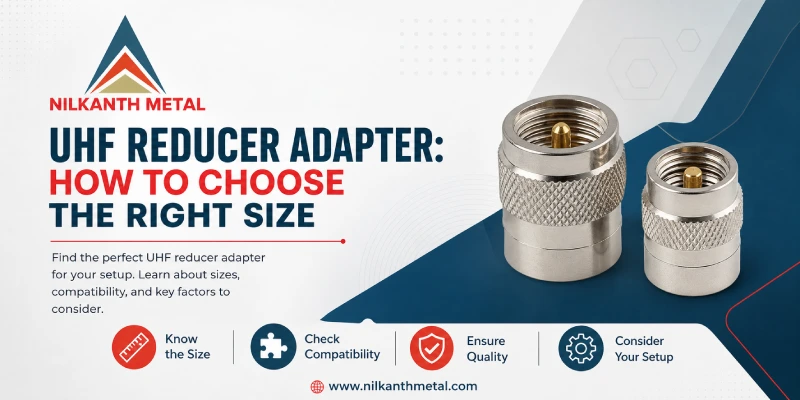
Coaxial cable comes in more diameters than most people expect, and a UHF connector built for RG-8 will sit loose and unreliable on a thinner run of RG-58. That mismatch is exactly what a uhf cable reduce adapter is built to solve, stepping a connector body down to grip a smaller cable without sacrificing the mechanical or electrical connection. This guide walks through how to match adapter size to cable diameter, when a reducer beats a full connector swap, and where the wrong choice quietly degrades signal.
A uhf cable reduce adapter lets a UHF connector body, typically sized for RG-8 or similar thick coax, grip a thinner cable like RG-58 or RG-59 by stepping down the internal collet or crimp diameter. Choosing the right reducer means matching it to the exact cable's outer diameter and dielectric size, not just its RG number, since manufacturers vary slightly on both.
Why Cable Diameter Determines Adapter Size
Cable outer diameter, not the RG designation alone, is what actually determines whether a reducer fits. RG-58 typically measures around 0.195 inches in outer diameter, while RG-8 runs closer to 0.405 inches, and a reducer bridges that roughly 0.2-inch gap by stepping the connector's internal bore down in stages rather than trying to close it in one jump.
Dielectric diameter matters just as much as the jacket measurement. The center conductor needs to seat against the connector's pin without gaps, so a reducer sized correctly for the outer jacket but wrong for the dielectric can still produce an intermittent or high-resistance connection that only shows up under vibration or temperature change.
Manufacturing tolerance varies more than most buyers assume between cable brands, even within the same RG number. Two spools labeled RG-58 from different manufacturers can differ by several thousandths of an inch in outer diameter, which is why physically measuring the cable with calipers before ordering a reducer beats trusting the RG label alone.
How Does a UHF Reducer Adapter Affect Signal Quality
Impedance mismatch is the main risk a poorly chosen reducer introduces into an otherwise clean RF path. UHF connectors themselves aren't a true 50-ohm design to begin with, which is generally fine at HF and low VHF frequencies, but a loose or oversized reducer adds an additional discontinuity that becomes more noticeable as frequency climbs past 300 MHz.
Return loss increases measurably when a reducer doesn't grip the cable's dielectric tightly. A gap of even a few thousandths of an inch between the reducer's bore and the cable's actual diameter can introduce enough impedance variation to raise VSWR from an acceptable 1.5:1 up toward 2:1 or worse, particularly on longer cable runs where the mismatch compounds.
Mechanical stability affects signal quality just as much as the electrical fit. A reducer that's crimped or soldered onto a cable slightly too thin for its collet will flex under strain, and that flexing creates intermittent contact that shows up as signal dropouts rather than a clean, consistent failure a technician can easily diagnose.
Choosing Between Crimp, Solder, and Compression Reducers
Crimp-type reducers, including the common uhf female crimp type connector style, use a mechanical press to compress a metal sleeve around the cable's braid and center pin. This method suits high-volume production environments because a properly calibrated crimp tool produces consistent results in seconds, though it requires the exact right die size for the cable diameter being used.
Solder-type reducers rely on heat to bond the center pin and sometimes the braid connection, which tends to produce a slightly more reliable electrical connection for one-off or low-volume repair work. The tradeoff is time and skill: a cold solder joint on a reducer is a common source of intermittent failures that crimp connections rarely produce when done correctly.
Compression reducers use a nut that tightens down over the cable jacket rather than crimping or soldering, sealing out moisture more effectively than either alternative. Outdoor antenna installations, particularly in coastal or high-humidity environments, generally benefit from compression-style reducers even though they cost more per unit than a basic crimp reducer.
| Reducer Type | Best For | Typical Reliability |
|---|---|---|
| Crimp | High-volume production, field installs | Consistent with correct die |
| Solder | Repairs, low-volume, one-off jobs | High if done correctly |
| Compression | Outdoor, weather-exposed runs | High, best moisture seal |
Matching Reducers to Connector Conversions
Adapting between connector families is a separate decision from cable-size reduction, though the two often get bundled into one purchase. A uhf female to bnc male plug adapter handles connector-family conversion, letting equipment built for BNC connections interface with UHF-terminated cable, and it's a common need when older radio gear meets newer test equipment standardized on BNC.
Panel-mount applications frequently call for a different configuration entirely. A uhf female to female 1 inch adapter, sized to fit a standard bulkhead panel cutout, lets two UHF-terminated cables connect through an enclosure wall without either cable needing a connector change, which is standard practice in amateur radio base stations and marine electronics installations.
Stacking multiple adapters, while sometimes unavoidable, adds cumulative signal loss and mechanical points of failure that a single correctly specified adapter avoids. Each additional connector interface typically adds a small but measurable insertion loss, often in the range of 0.1 to 0.3 dB per junction at UHF frequencies, which adds up quickly across three or four stacked adapters.
Weatherproofing becomes a real concern once any adapter, reducer or otherwise, sits outside an enclosure. Self-amalgamating tape wrapped over the connection point, followed by a layer of standard electrical tape as a UV barrier, is still the cheapest and most durable field fix for keeping moisture out of an exposed UHF joint over multiple seasons.
Buying Considerations for Bulk or Repeat Orders
Sourcing reducers and adapters in bulk changes the calculus compared to buying one or two for a single repair. A buyer ordering hundreds of units for production or resale needs consistent plating quality, since nickel or silver plating that varies batch to batch introduces contact resistance differences that are hard to catch until units are already installed in the field.
Requesting sample units before committing to a full order catches dimensional drift early. A supplier willing to send five or ten sample reducers for measurement and test-fitting against actual cable stock is generally a safer long-term source than one offering only a spec sheet and a price per thousand.
Lead time and minimum order quantity often matter as much as unit price for industrial buyers. A supplier with shorter lead times on common sizes, even at a slightly higher per-unit cost, frequently works out cheaper overall once a production line's downtime cost from a stockout is factored in.
Frequently Asked Questions
What is a UHF reducer adapter used for?
A UHF reducer adapter lets a UHF connector, normally sized for thicker coax like RG-8, grip and terminate a thinner cable such as RG-58 or RG-59 without needing a full connector replacement. It's commonly used when upgrading or repairing radio and antenna systems where the original cable size no longer matches available connectors.
Does a UHF connector work at high frequencies?
UHF connectors perform reliably up to roughly 300 MHz but start showing more signal loss and impedance inconsistency above that point, which is why they remain a mainstay in amateur radio and CB applications rather than higher-frequency commercial RF work. Applications above 1 GHz generally use N-type or SMA connectors instead for better consistency.
How do I know what size reducer I need?
Measure the cable's actual outer diameter with calipers rather than relying on its RG number alone, then match that measurement against the reducer manufacturer's specified diameter range. When in doubt, cutting a short test length and dry-fitting it into the reducer before crimping or soldering avoids a wasted connector.
Can I use a UHF to BNC adapter permanently, or should I re-terminate the cable?
A uhf female to bnc male plug adapter works fine for permanent installations as long as it's rated for the expected frequency and environmental exposure, though re-terminating with a native BNC connector eliminates one interface and slightly reduces insertion loss. For most amateur and light commercial use, the adapter approach is perfectly adequate.
Do reducer adapters weaken the coaxial cable's shielding?
A correctly installed reducer, whether crimp, solder, or compression type, maintains shielding continuity as effectively as a properly sized native connector. Shielding problems typically come from a poor installation, not the reducer design itself, which is why verifying continuity with a multimeter after installation is worth the extra two minutes.
The right uhf cable reduce adapter comes down to a tape measure and a set of calipers more than any spec sheet, since the difference between a connection that lasts years and one that fails within months usually traces back to whether someone actually measured the cable before ordering the part. Keep a small assortment of common reducer sizes on hand for field work, and most connector mismatches stop being emergencies at all.
Recent Post
August, 20 2025
UHF Plug Connector: A Comprehensive Guide



April, 28 2025
Your Trusted Source for High-Quality Brass Air Valves


February, 14 2025
Versatile Brass and Steel Screws Customized for Industrial Sectors

July, 19 2024
What is Core Vents?